

For many people, investing feels complicated—full of terms, charts, and strategies that seem out of reach. The truth is, you don’t need advanced math skills or Wall Street experience to become a successful investor. What you do need is a solid understanding of the building blocks of investing—also known as asset classes and how they work together.
From the security of a savings account to the growth potential of stocks, every type of investment carries its own balance of risk and reward. Learning where each one sits on the investment risk ladder gives you the foundation to make smart decisions and start your financial journey with confidence.
Table of Contents
Key Takeaways
- Every investment falls somewhere on the risk ladder—cash is safest but lowest-returning, while alternative investments carry higher risk with the potential for bigger rewards.
- For beginners, index funds or ETFs that mirror the overall market are often the smartest starting point.
- Over the long term, stocks have outperformed bonds, though they also come with greater short-term ups and downs.
- Diversification—spreading your money across different investment types—is one of the most effective ways to manage risk.
- Different asset classes perform better in different economic conditions, so knowing when to hold and when to rebalance is key.
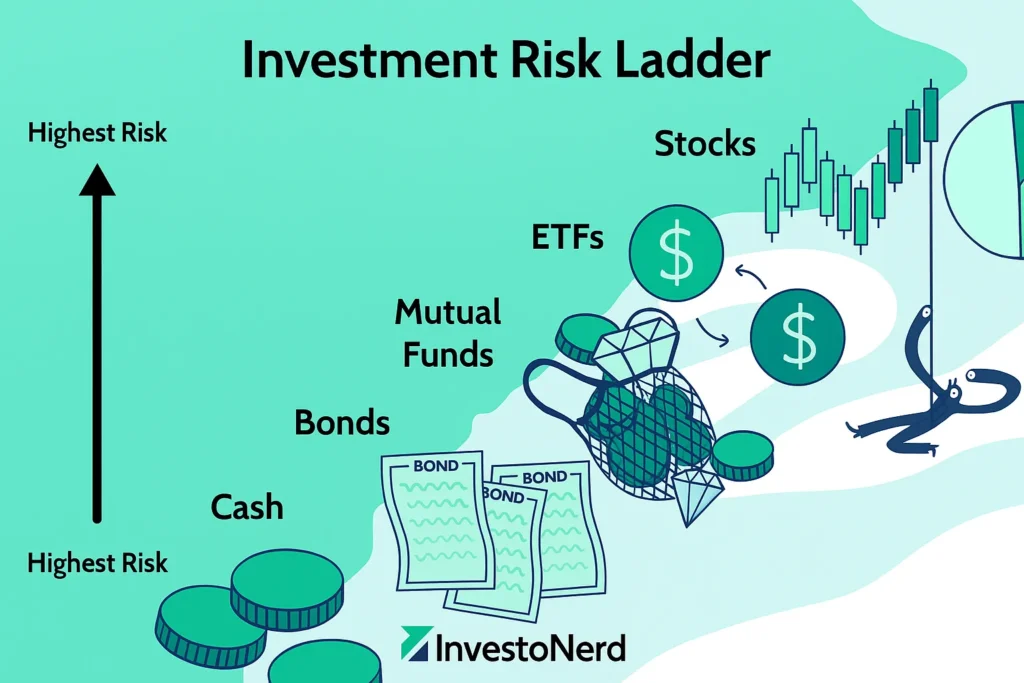
Understanding the Investment Risk Ladder
Investments can be thought of as rungs on a ladder. The lower rungs—like cash—are the safest, but they also deliver the smallest returns. As you climb higher toward stocks and alternatives, potential rewards increase, but so does the level of risk. Knowing where each asset sits helps you decide how much of your money should go into each category.
Cash
Cash deposits are the most straightforward investment. A savings account offers security, easy access, and a small amount of interest. The main drawback is that returns rarely keep up with inflation, meaning your money slowly loses purchasing power.
Certificates of deposit (CDs) can pay higher rates than savings accounts, but your money is locked in for a set period. Early withdrawals usually trigger penalties, making them less flexible.
Tip: Financial planners often suggest using cash primarily for short-term goals or emergency funds, not long-term growth.
Bonds
A bond is essentially a loan you make to a company or government. In exchange, they pay you interest on a fixed schedule. U.S. Treasury bonds are among the most widely used and trusted worldwide.
Bond prices are heavily influenced by central bank interest rates. When rates rise, the value of existing bonds often falls, and when rates drop, bond values usually climb. Bonds generally provide steadier returns than stocks, but with lower growth potential.
Mutual Funds
Mutual funds allow many investors to pool money together, which a professional manager then invests in a mix of stocks, bonds, or other assets. This gives you built-in diversification—even with a small investment.
- Passive funds track a market index, like the S&P 500. They aim to mirror the market’s performance and typically charge lower fees.
- Active funds are run by managers who try to outperform the market. They require more oversight but often come with higher fees.
Unlike individual stocks, mutual funds are priced only once a day, based on their net asset value (NAV), which reflects the total value of all the investments inside the fund.
Tip: Diversified mutual funds can help new investors avoid the temptation to “time the market” and instead focus on steady, long-term growth.
Exchange-Traded Funds (ETFs)
ETFs are similar to mutual funds in that they hold a basket of investments, but they trade on stock exchanges throughout the day. That means you can buy and sell them just like individual stocks.
Many ETFs track indexes, sectors, or even commodities. Their flexibility, low fees, and wide range of options have made them one of the fastest-growing investment vehicles for both everyday investors and large institutions.
Stocks
When you buy stock, you’re purchasing ownership in a company. Returns can come from two sources:
- Price appreciation – selling your shares for more than you paid.
- Dividends – payments some companies make to shareholders from their profits.
Stocks can deliver strong long-term growth but also carry significant short-term risk. Large, established companies (like Coca-Cola or Johnson & Johnson) tend to be steadier, while small-cap or emerging firms may grow faster but with greater volatility.
Fast Fact: Companies that have increased dividends for 25+ consecutive years are called dividend aristocrats—and they’re often favored by income-focused investors.
Alternative Investments
Beyond the traditional mix of cash, bonds, and stocks, alternatives provide other ways to diversify:
- Real estate: Direct property ownership or investing in REITs (real estate investment trusts) that trade like stocks.
- Hedge funds & private equity: Complex, higher-risk strategies typically limited to wealthy or accredited investors.
- Commodities: Physical goods like gold, oil, or agricultural products. They are often used as a hedge against inflation.
Alternatives can play a valuable role in some portfolios, but they usually come with higher risks, less liquidity, and greater complexity.
Setting Realistic Expectations for Assets in Any Economy
Every asset class responds differently depending on the state of the economy. Knowing how they behave in various conditions helps you set realistic expectations and avoid surprises.
Cash
- Best in: Times of uncertainty or when you need quick access to money.
- Drawback: Savings rates often fail to keep up with inflation, eroding purchasing power.
Bonds
- Best in: Periods of falling interest rates, when bond prices typically rise.
- Drawback: In a high-rate environment, existing bonds can lose value, and returns may lag behind inflation.
Stocks
- Best in: Expanding economies, when companies grow and profits rise.
- Drawback: Stocks are more volatile and can swing sharply during recessions, corrections, or political uncertainty.
Real Estate
- Best in: Periods of economic growth and rising demand, as property values and rents increase.
- Drawback: Can be less liquid (harder to sell quickly) and may fall in value during downturns or when interest rates rise.
Commodities
- Best in: Inflationary times, since goods like oil and gold often hold or increase in value.
- Drawback: Highly cyclical and dependent on global supply and demand, making them riskier for everyday investors.
Diversification is Key
No single investment thrives in all conditions. That’s why spreading your money across different asset classes—cash, bonds, stocks, real estate, and more—helps balance risk and reward. A well-diversified portfolio ensures that when one part struggles, another may provide stability or growth.
Reminder: Market cycles are normal. Instead of trying to predict short-term shifts, focus on long-term goals and rebalance your portfolio periodically.
The Bottom Line
Investing doesn’t have to be complicated. At its core, it’s about understanding the trade-off between risk and reward and choosing the right mix of assets for your goals. Cash offers stability, bonds provide steady income, stocks deliver growth, and alternatives like real estate or commodities add extra layers of diversification.
The smartest approach is often the simplest:
- Start with broad, low-cost funds.
- Diversify gradually across asset classes.
- Stay focused on long-term goals instead of short-term market noise.
By building a portfolio that balances safety and growth, you give yourself the best chance of growing wealth over time—no matter what the economy brings.
Simplifying finance with clear insights on credit, loans, insurance, and investing – InvestoNerd.
Related Articles
- Top Economist Warns: Rising Inflation and Slowing Growth Are Investors’ Worst Nightmare

- Best High-Yield Savings Accounts in September 2025: Maximize Your Cash While Rates Last
- Investing: An Introduction
- How To Start Investing in Stocks in 2025 and Beyond

- The 10 Richest People in the World (September 2025 Update)

- How Do I Keep Commissions and Fees From Eating Trading Profits?

- 4 Basic Things to Know About Bonds

- What Are Stock Fundamentals?